

On the first day of school, our Kindergarten students stood underneath a Tallit as Rabbi Abe Schacter-Gampel, gave a special bracha, a blessing, to our students, inaugurating them and their parents into formal Jewish Day School education.
The Tallit symbolized the students’ first home; a place where they are to be protected, educated, loved, and nurtured. On our wedding day, we stand underneath a wedding canopy, often a simple Tallit. The chuppah symbolizes our first home as a married couple.

It is just a roof. No walls, just a protective covering. In a few weeks, we will read the story of Abraham and Sarah, whose tent walls were always open for all to come and visit. Abraham and Sarah are known as the role models for Hachnasat Orchim, welcoming guests to their home.
This coming Sunday evening, we will begin the holiday of Sukkot. On each night of Sukkot, we invite guests into our home. While we invite our friends and family, we also “invite” spiritual guests, known as the Ushpizin. These “guests” are personalities from the Tanakh, yet many have the custom to invite modern Ushpizin (Jews of stature from modern times).
A Sukkah is a temporary structure. A Sukkah must have at least three walls. It must be taller than ten tefachim, handbreadths (top knuckle to bottom knuckle, about 3-4 inches). It cannot be taller than twenty amot (one amah is about 18 inches, 20 amot is about 30 feet). These rules are to maintain the temporary status of our Sukkah. A Sukkah is covered with schach, branches that need to provide more shade than sun (implying that some sun must come in).
A Sukkah has walls but not a solid roof, while a chuppah has a full roof (cover) but no walls. Why the apparent reversal of a chuppah?

These words, which open our morning service each day, perhaps answer the question best. Each clause in the paragraph is connected to the idea of a home.
The difference between a Sukkah and a Chuppah is in the permanence. We purposefully build our Sukkah knowing that its protection is only temporary. It is around us but not completely above us. Once Sukkot is over, we will take it down and move back indoors, searching for a solid roof over our heads. On our wedding day, we recognize that there is something permanent, something that will protect us and shield us.
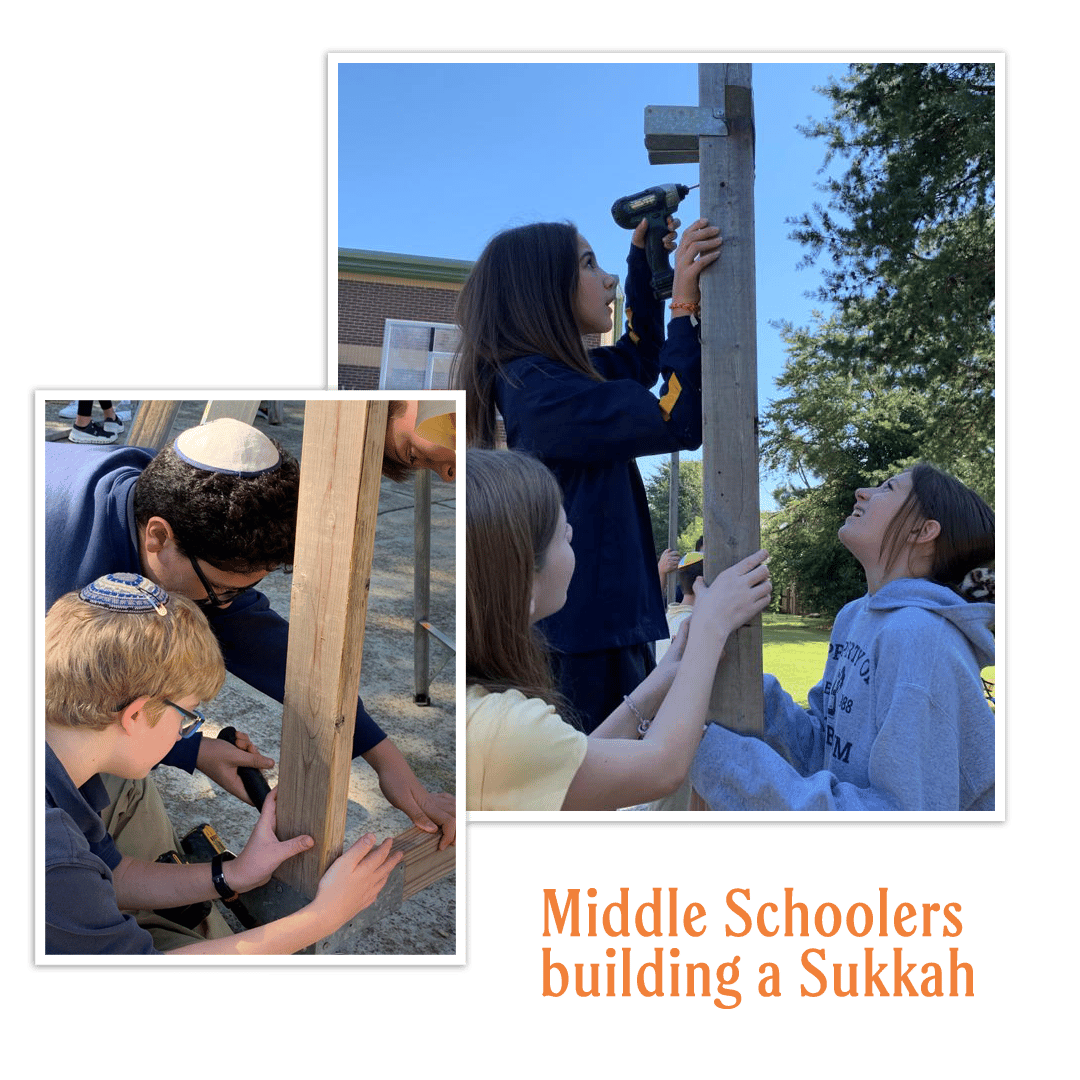
At Bornblum we realize that our walls may be temporary, but the Tallit that we put over our heads in Kindergarten will never be lifted. Our walls and doors are always open to guests (our Ushpizin), who are invited to visit. Our study of Torah “is equal to them all”. As long as we are together, learning and growing, we have you covered.
Chag Sameach.
